

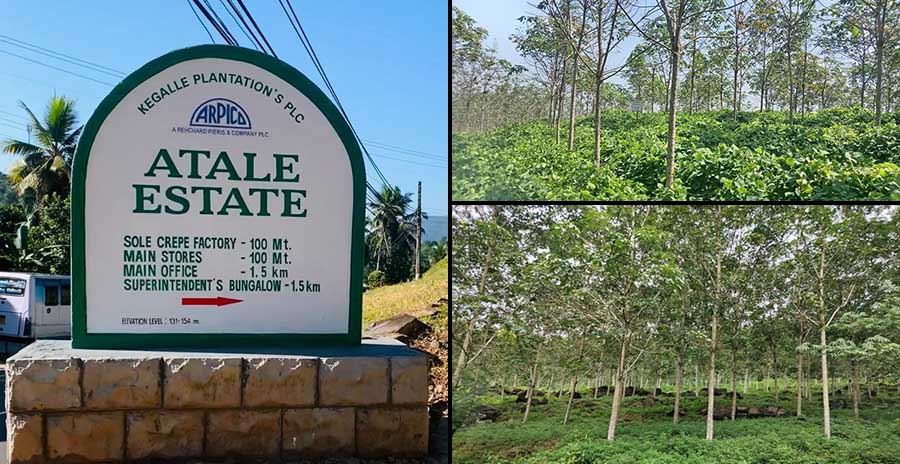
It was originally part of the extensive holdings of Messrs. Grand Central (Ceylon) Rubber Estates Ltd., which managed more than 43,000 acres through Carson Cumberbatch & Company.
Over time, the estate evolved, gradually incorporating neighboring properties such as Maboda, Boyagoda, Dickhena, New and Old Arandara and later the Dorpet and Myland estates.
During the colonial era, several of these functioned as independent estates, with Pindenioya Estate even operating its own rubber factory and engaging in tea cultivation.
The estate’s long journey mirrors the broader transformation of Sri Lanka’s plantation industry, from early commercial expansion to post-independence nationalization and eventual corporate restructuring.
Following the Land Reform Act of 1976, Atale Estate came under the management of the Janatha Estates Development Board (JEDB) until privatization in 1992 vested the estate with Kegalle Plantations PLC.
Administrative integrations over the decades expanded the estate to its present extent of 1,142 hectares, making it the largest rubber estate in the country.
Today, it spans seven Grama Niladhari divisions in the Kegalle District and continues to benefit from the stewardship of seasoned planters whose expertise has shaped its long-term success.
Despite significant challenges, their leadership has ensured that the estate and its factory maintained high standards of productivity, environmental responsibility and operational excellence right through to the present day.
Sustainable Plantation Management, Research-Driven Practices and Environmental Commitment
Atale Estate’s strength lies in its advantageous location within Sri Lanka’s low-country Wet Zone and its commitment to sustainability-focused plantation management.
The estate benefits from abundant rainfall ranging between 2,000 and 3,000 millimetres annually, coupled with a warm average temperature of approximately 27.8°C.
High humidity levels help maintain soil moisture and reduce evapotranspiration, ensuring optimal conditions for rubber cultivation.
The diverse topography, consisting of gently undulating and moderately sloped terrain, supports effective drainage and plantation accessibility, while fertile Red-Yellow Podzolic and Reddish Brown Latosolic soils promote strong root development.
The naturally acidic nature of this soil, shaped by the region’s weather patterns, is ideally aligned with rubber’s agronomic requirements.
To preserve long-term soil health and environmental stability, the estate practices soil conservation through the introduction of cover crops and careful land-use planning.
Crop diversification has been incorporated into the estate’s strategy, with oil palm, coconut and agarwood cultivated alongside rubber.
Additionally, more than 100 hectares have been replanted with recommended rubber clones, aligning with guidance from the Rubber Research Institute of Sri Lanka and other national agricultural authorities.
The estate’s alignment with scientific institutions strengthens its commitment to adopting modern technologies, research-driven methods and environmentally sound production processes.
Atale’s sustainability credentials are bolstered by its Forest Stewardship Council (FSC) certification.
First obtained in 2019, the certification ensures compliance with international standards on environmental protection, social responsibility and stakeholder engagement.
Atale estate operates with meticulously prepared management plans, biodiversity assessments, environmental and social impact analyses and a series of updated policies on areas such as labour conditions, corruption prevention, gender equality, informed consent and community rights.
Conservation zones within the estate have been expanded and enriched with native tree species, supported by continued mapping updates, disease monitoring and long-term growth data from permanent sample plots.
These initiatives highlight Atale’s dedication to maintaining ecological balance while improving plantation productivity.
Excellence in Processing, Community Development and a Forward-Looking Estate Legacy
The Atale Rubber Processing Centre remains one of Sri Lanka’s foremost facilities for manufacturing sole crepe and pale crepe rubber.
With daily production exceeding 5,000 kilograms of natural rubber, the factory has evolved significantly from its origins as a crepe rubber facility.
Investments made after the 1992 privatization enhanced its capacity through improved settling tanks, expanded bulking operations and a dedicated Effluent Treatment Plant to ensure environmentally safe waste discharge.
This focus on quality and sustainability has earned the factory several prestigious recognitions, including ISO 9001:2015 compliance and FSC (FM and COC) certification.
In 2015, Atale became the first natural rubber processing facility in Sri Lanka to receive the National Green Award in Gold Category, marking a milestone in the country’s rubber sector.
At auction platforms run by the Colombo Rubber Traders’ Association, Atale’s products consistently secure premium prices, which confirms their reputation for purity, consistency and quality.
Worker welfare and community empowerment form an essential part of the estate’s legacy.
The Estate Workers’ Cooperative Society offers financial support through loan schemes, savings facilities, fixed deposits and welfare benefits.
Community-building activities such as annual excursions, distribution of school supplies, Vesak alms-giving and financial assistance during bereavement, strengthen the social fabric of the estate.
Through a long-standing partnership with the Plantation Human Development Trust (PHDT), Atale Estate has implemented diverse initiatives including medical camps, housing upgrades, sanitation improvements, women’s health clinics and nutrition programs.
These initiatives ensure transparent governance and improvements in the living standards of estate families.
Strong institutional collaborations with the Rubber Research Institute of Sri Lanka, the Coconut Research Institute and other national bodies continue to support Atale Estate in research, training and technological advancement.
Together, these partnerships reinforce the estate’s position as a leader in sustainable plantation management and responsible industrial production.
Across more than a century of operations, Atale Estate has built a legacy in innovation and community upliftment.
Today, it stands as a model of preserving environmental integrity, championing worker welfare and significantly contributing to the nation’s rubber industry.