
Kaspersky Launching AI Protect in Asia Pacific to Defend Enterprises Against Rising AI-Powered Threats
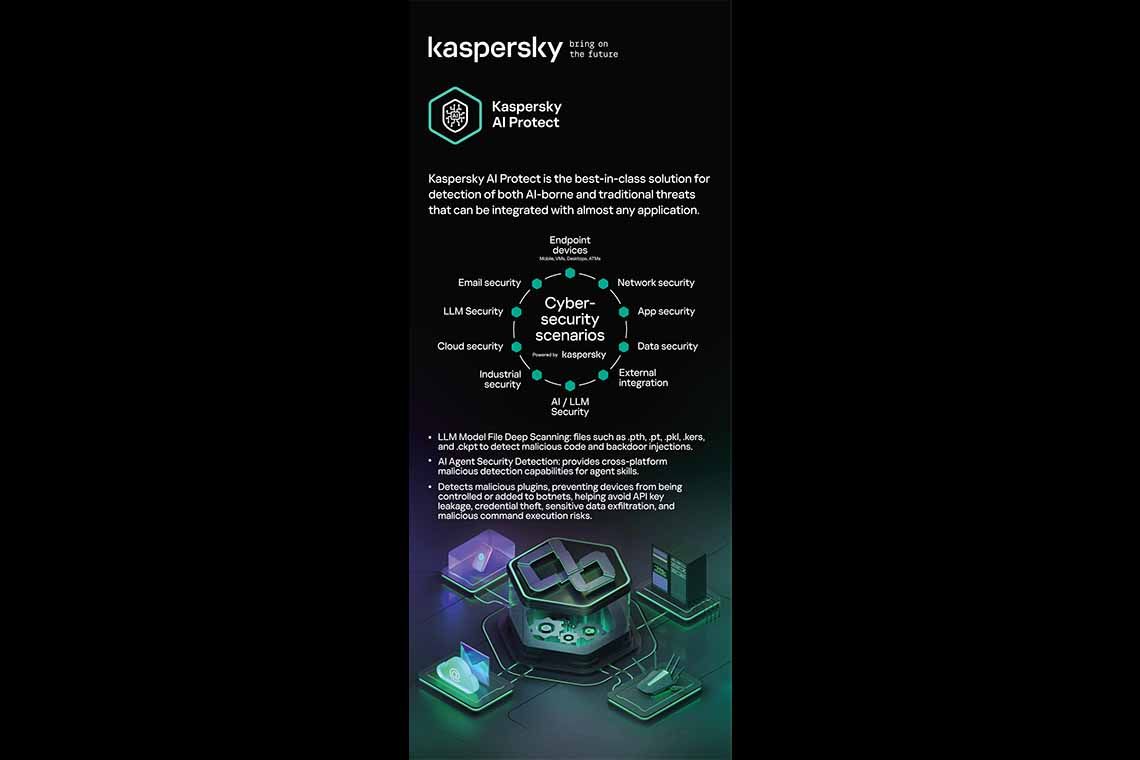
Kaspersky is officially launching Kaspersky AI Protect (KAIP) across the Asia Pacific region, introducing a purpose-built solution designed to secure enterprise AI infrastructure against a new generation of threats, from poisoned Large Language Model (LLM) files and malicious AI agents to conventional cyberattacks that continue to evolve alongside AI adoption.
The launch comes as the Asia Pacific region has emerged as a global cyberattack hotspot, accounting for over 60 percent of recorded attacks worldwide.
Manufacturing and IT services are the most targeted sectors, while small and medium enterprises across industries face severe exposure due to inadequate defense capabilities.
At the same time, AI adoption across enterprise environments in the region is accelerating rapidly, and threat actors are moving just as fast.
Globally, Kaspersky data shows that over 92,000 malicious attacks disguised as AI services were recorded in the first half of 2026 alone.
"The Asia Pacific region is at a critical inflection point. Enterprises are accelerating AI adoption and prioritizing speed to business value, yet many underestimate the real-world threats that come with it, including AI supply chain risks, model poisoning, malicious agents, and prompt injection attacks,” said Adrian Hia, Managing Director for Asia Pacific at Kaspersky.
“Many organizations still hold the misconception that keeping large language models in-house makes them safe.
But that overlooks how malicious code can be smuggled in through model weights, AI plugins, and skill scripts sourced from outside the organization," Hia added.
KAIP directly addresses this gap with new features enabling it to check LLM files and AI agents for malicious functionality, while retaining mature protection against traditional cyber threats.
“Security should not act as a barrier to AI advancement, but rather as an enabler that unlocks AI's scalable value.
We are committed to embedding security into every stage of the AI lifecycle, from model import to agent execution, helping enterprises across Asia Pacific integrate AI security into existing security operations workflows to balance innovation and risk control,” Hia further said.
KAIP is a best-in-class solution for the detection of AI-borne as well as traditional threats that can be integrated with almost any application.
It provides comprehensive protection for web portals and applications, proxy servers, network-attached storage, and mail gateways, and is easy to manage and deploy through HTTP and ICAP as a standalone service, scalable cluster, or Docker container.
As enterprises across APAC adopt increasingly diverse AI architectures, from on-premises LLM frameworks to RAG knowledge bases and AI agent orchestration platforms, conventional endpoint and network-perimeter defenses lack the dedicated detection capabilities needed for LLM weight files and AI-agent skill files, leaving critical entry points vulnerable.
KAIP directly addresses this gap with new features enabling it to check LLM files and AI agents for malicious functionality, while retaining mature protection against traditional cyber threats.
"Security should not act as a barrier to AI advancement, but rather as an enabler that unlocks AI's scalable value.
From model import to agent execution, we are committed to embedding security deep into the full AI lifecycle, as well as helping enterprises across Asia Pacific integrate AI security into existing security operations workflows to balance innovation and risk control," said Simon Tung, General Manager for ASEAN and Asia Emerging Countries (AEC) at Kaspersky.
KAIP is available for Linux environments and can be deployed as an individual container, to Docker Swarm, Kubernetes, AWS EKS, and similar cloud environments.
As part of the Kaspersky Technology Alliance ecosystem, it can be integrated into third-party hardware and software security offerings, with comprehensive technical cooperation support available for partners.
"At the end of the day, you cannot secure what you cannot see.
KAIP gives enterprises visibility into the parts of their AI infrastructure that have been left unprotected for too long.
We built this because the threats are real, they are growing, and organizations across Asia Pacific cannot afford to find out the hard way," Tung further said.
About Kaspersky
Kaspersky is a global cybersecurity company and digital privacy company founded in 1997.
Innovating the industry with a Cyber Immunity approach, Kaspersky safeguards consumers, businesses, critical infrastructure, and governments from cyberthreats, with over a billion devices protected to date.
Kaspersky ensures Cybersecurity True to Business, focusing on providing clear outcomes, protecting revenue, easing workloads and preventing downtime.
Kaspersky’s deep threat intelligence and security expertise is constantly transforming into innovative solutions and services for organizations of every size, from small businesses to large enterprises, combining proven AI-driven protection technologies with simple management and expert support.
Recognized in independent tests and trusted by millions of individuals worldwide and nearly 200,000 organizations, Kaspersky helps detect threats earlier, respond faster and operate with greater confidence and freedom, protecting what matters most to our clients.
Learn more at www.kaspersky.com.
Latest Posts











Video

K9 unit flown by Emirates SkyCargo to Zimbabwe begins frontline operations
Vega and Kuda, two specialist conservation dogs, transported by Emirates SkyCargo from London to Harare via Dubai in partnership with UK charity Dogs 4 Wildlife, have arrived safely and acclimatise